WELCOME TO PI
Info About PI
Why a Prosthodontist?
Meet Our Doctors
Research Programs
What's New At PI?
Free Video Offer


DENTAL
TREATMENT

Dental Implants
Treatment Options
Prosthesis Types
Bone Grafting
Dental Implants &
Congenital Deformities
Bad Breath
Orthodontic Treatment
Combined with
Procera Crowns


HEALTH-ISSUES
AND DENTISTRY
Bone Loss and Aging
Heart Illness & Dentistry
Snoring/Sleep Apnea
Osteoporosis
Cancer Information
Drugs and Dentistry
Smoking & Implants
Other Medical

INSIGHTS NEWSLETTERS
Fall 2004, Vol. 17, No 2

Spring 2004, Vol. 17, No.1
Spring 2003, Vol. 16, No. 1
April 2002, Vol. 15, No. 1
Nov 2001, Vol. 14, No. 2
April 2001, Vol. 14, No. 1
May 2000, Vol 13, Num 1
Oct 1999, Vol 12, Num 2
May 1999, Vol 12, Num 1
Nov 1998, Vol 11, Num 2
Jan 1998, Vol 11, Num 1
Feb 1997, Vol 10, Num 1
Sept 1996, Vol 9, Num 2
August 1995, Vol 8, Num 2
Sept 1993, Vol 6, Num 2
October 1990, Vol 4, Num 2

Prosthodontic Insights Newsletter

September 1993,
Volume 6., No. 2

Featured Articles:

  • Replacement of congenitally missing teeth with orthodontics and osseointegration. Balshi, Periodontics and Restorative Dentistry, Vol. 13, No. 6, 93.
  • A Comparison of Torsional Ductile Fracture In Implant Coronal Screws, McGlumphy et al. Journal of Dental Research, March 1992.
  • A Retrospective Evaluation of Endosseous Titanium Implants in the Partially Edentulous Patient, Pylant et al, International Journal of Maxillofacial Implants 1992; 7: 195-202.
  • Effect of Fluoride Prophylactic Agents on Titanium Surfaces, Probster et al. International Journal of Maxillofacial Implants 1992; 7: 390-394.
  • Esthetic Achievements in Partial Edentulism With the Brånemark System, Nobelpharma Challenges, San Diego 1992.
  • Is Osteoporosis a Risk Factor for Osseointegration of Dental Implants? Dao et al
  • Placement of Implants Into Fresh Extraction Sites Using a Resorbable Collagen Membrane: Two Case Reports: Sevor and Meffert, Practical Periodontics and Aesthetic Dentistry, April 1992, Vol. 4, No. 3.
  • Loads and Designs of Screw Joints for Single Crowns Supported By Osseointegrated Implants. Jorneus et al. International Journal of Maxillofacial Implants 1992; 7: 353-359.

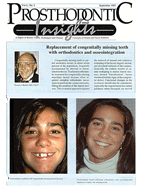
Replacement of congenitally missing teeth with orthodontics and osseointegration

Thomas J. Balshi, D.D.S., F.A.C.P.

Congenitally missing teeth or partial anodontia occurs in about seven percent of the population, frequently accompanied by aberrant or diminished tooth size. Traditional orthodontic treatment for congenitally missing maxillary lateral incisors often required complete orthodontic movement to position the canines mesially, filling the position of the lateral incisors. This treatment approach requires the removal of enamel and extensive reshaping of the facial, lingual, incisal, and proximal surfaces of the canines. Generally, the esthetic results of canine reshaping to mimic lateral incisors, termed "lateralization", leaves unnatural telltale signs of the congenital defect. Functional changes in the occlusion should also be considered, especially the requirements for canine guidance when bicuspids are moved anteriorly. There is concern for the added forces imposed on bicuspids with shorter and thinner roots. Moving the canine into the lateral position will effect the entire occlusal scheme.
With improvement of prosthodontic methods for replacing congenitally missing teeth, modern orthodontics is significantly changing its treatment philosophy. The goals of this new approach in orthodontics are the establishment of an ideal occlusal relationship, the best possible masticatory function, and the most esthetic appearance.

Current prosthodontic methods for replacing congenitally missing teeth include traditional fixed prosthodontics, resin bonded (Maryland) bridges, removable partial dentures, or osseointegrated implants to support an independent anatomically contoured crown. Proper execution of the first three methods requires varying degrees of tooth preparation.

The most biologically conservative approach for the replacement of congenitally missing teeth is the osseointegrated implant. Use of Brånemark implants to replace congenitally missing incisors requires a coordinated team approach. The orthodontist takes the lead role in establishing the ideal position of the dentition, especially the teeth immediately adjacent to the anticipated implant site. Factors to consider are:

Root position: A minimum of 1mm of bone should be available between the implant threads and the adjacent root surfaces.

  • Interdental space: Minimal interdental space of 7mm provides sufficient osseous support to maintain the interdental papilla.

  • Esthetic aspects: The crestal aspect of labial bone and the top of the implant should be 2-3mm apical to the CEJ of the adjacent teeth. The CeraOne Abutment system is ideal for the single tooth restoration and provides a variety of titanium collar lengths to accommodate various anatomic conditions.

  • The alveolar ridge: A minimum of 6mm of facial-lingual bone is required for placement of the standard 3.75 mm diameter Brånemark implant. If the alveolus is narrower than the diameter of the implant body, several methods of guided osseous generation are available to build a wider ridge.

  • Loading the implant: Loading of the single implant and the crown appear to be well tolerated in spite of the load not being applied directly to the long axis. When a deep overbite condition exists, a custom ceramo/metal crown may be required to provide adequate support for the incisal porcelain.

  • Implant length and angulation: Maximum implant length provides the best initial stability and establishes precise conditions for future implant survival.

  • Post-orthodontic retention: Osseointegrated Brånemark implants replacing congenitally missing teeth provide ideal intra-arch stabilization points following active orthodontics.

  • Long term maintenance: Plaque control procedure similar to those recommended for the natural teeth are suitable for healthy maintenance of the surrounding mucosa. Periodic professional care must be part of the treatment plan.

    Post treatment

    Conclusion (State of the Art Treatment)

    Orthodontic treatment of patients with congenitally missing teeth, especially maxillary lateral incisors, can best be accomplished by positioning the remaining dentition in the anatomically correct location. This mandates close coordination of therapy with the osseointegration team members. Use of the Brånemark System® of implant therapy is the treatment of choice for the permanent replacement of congenitally missing teeth.

  • Download PDF File for this Insights (September 1993, Vol. 6, No. 2)

    Click here to see an Overview of Pi Dental Center

    More Information

    Home | Write Us to Request Information or Ask a Dental Question


    To make an appointment for an evaluation, call:
    1-800-PI-TEAM-5

    1-800-748-3265

    All information is intended for your general knowledge only and is not a substitute for dental or medical advice or treatment for specific dental or medical conditions. You should seek prompt dental and medical care for any specific health issues. See disclaimer.

    Copyright 2009 Pi Dental Center (Prosthodontics Intermedica).