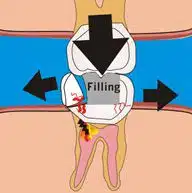
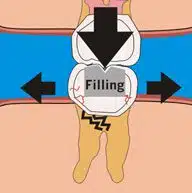
Large fillings destabilize teeth and, and over time, biting forces of the opposing teeth can cause cracks, breakage, inflamed roots and pain. We recommend placing a crown instead of large filling to avoid additional problems. Read this page to learn how biting forces affect teeth with large fillings.
When a patient has a cavity (caries), the dentist must consider whether a composite restoration (filling) or a crown is the best option to repair the tooth. If the cavity is large, biting forces exerted on the tooth must be considered.
Biting Forces
Chewing exerts tremendous forces on the teeth, when a person chews. Up to 573 pounds can be exerted on the molar teeth! This is why it is so important for dental restorations to be strong enough to withstand those forces. Once a filling becomes too wide or too deep, the integrity of the tooth is compromised.
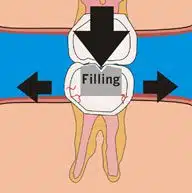
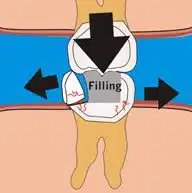
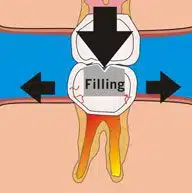
Large fillings destabilize teeth and, over time, biting forces from the opposing teeth can cause cracks, breakage, inflamed roots and pain.
Biting forces can cause the tooth to crack at the base. Decay can occur causing tooth to fracture.
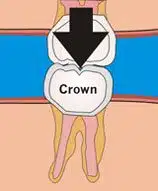
Complete crowns are restorations that cover the entire tooth. These restorations are a better option because they provide more stability than a large filling.

Solution
Instead of using a large filling, the prosthodontists at Pi Dental Center place a crown. This gives the tooth more stability and increases the tooth longevity.
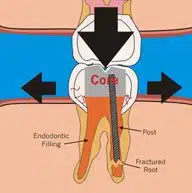
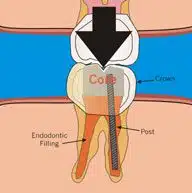
Click here to learn more about this subject.
How strong are your teeth? Read this blog to find out.